The show’s over. There’s a spreadsheet of 212 badge scans on your desk and sales wants to know who to call.
My advice: start with the companies that came back to your website. Someone who’s serious about buying goes back to the office and looks you up. Someone who came for the free pen doesn’t.
At Snitcher, we show you which companies visit your website, even when nobody fills in a form – so you can see which of your 212 scans looked you up.
Why isn’t the badge-scan list enough?
Because it can’t tell you who’s interested.
Everyone on it looks the same. The production manager with a budget and a deadline is one row. The student who wanted a free pen is the next.
You know what happens next. Your reps start at the top and work down. By the twentieth “I only picked up a brochure”, they’ve given up – and the company with a real project was on row 140.
Here’s who’s usually on the list and what they do after the show:
| Who you scanned | Why they stopped | What they do after the show |
|---|---|---|
| Someone with a live project | They need what you make | Look up the product they saw and send it to a colleague |
| An existing customer | To say hello | Nothing new |
| A brochure collector | Your stand looked interesting | Nothing |
| A supplier or a competitor | To sell to you, or to have a look | Maybe a peek at your “about” page |
| A student | The free pen | Nothing |
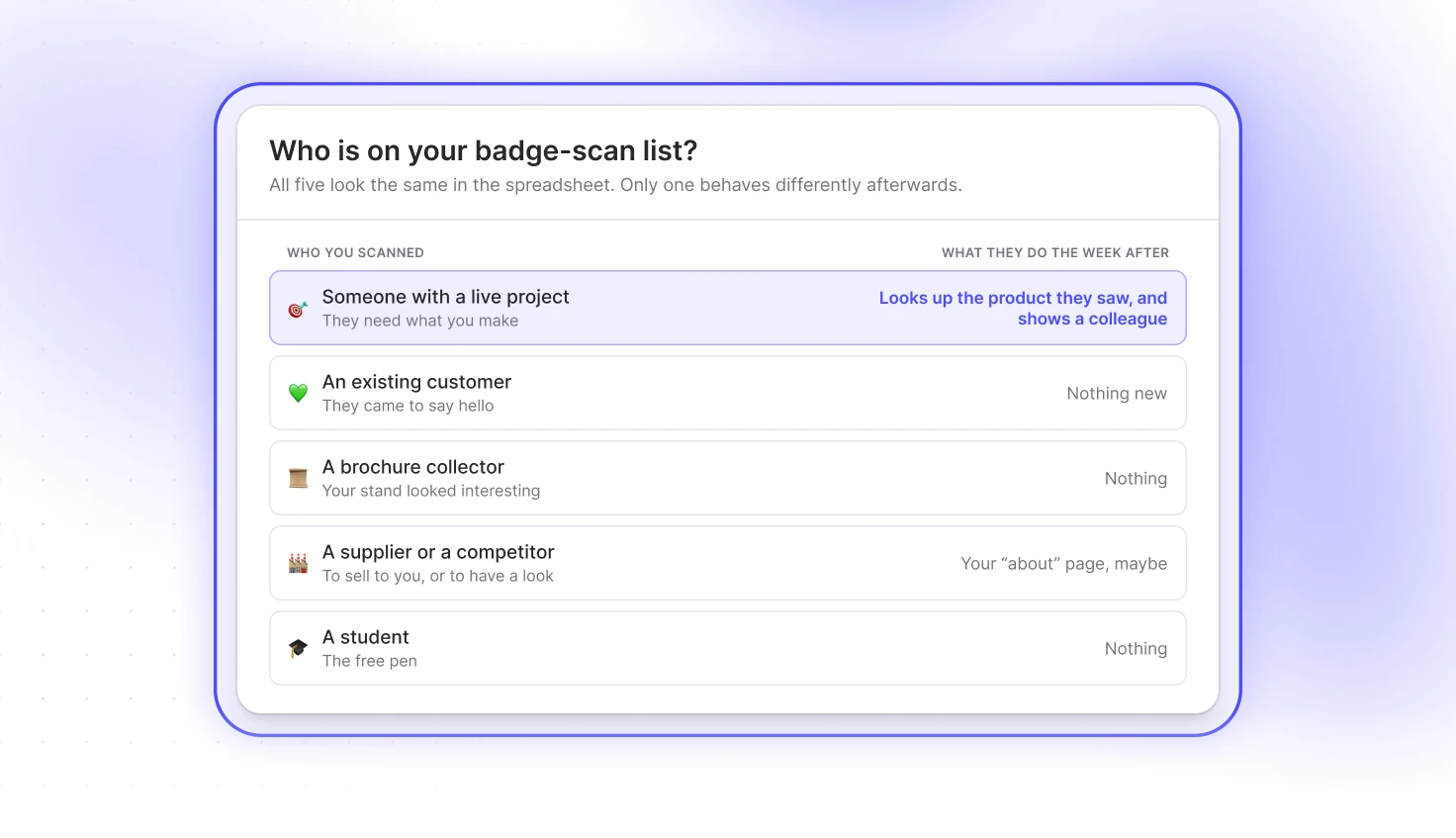
Only the first row does anything useful after the show. They look you up – on your website, where the spreadsheet can’t see it.
How do you see which companies came back to your website?
Most website visitors never fill in a form, so normally you’d have no idea who they are.
Website visitor identification fixes that.
When someone browses your website from work, the visit comes from their employer’s network. Snitcher looks up whose network it is and tells you the company, which pages it read and when it came back.
So if that production manager reads your product pages from the office, you’ll see their company’s name. They don’t have to fill in a thing.
Here’s how to set it up for a show:
- Turn the scans into a list of companies. Badge scans are people, but Snitcher matches companies. One row per company, with its website address. Five people from the same firm are one row.
- Upload the list to Snitcher the day you get back. Visits start while you’re still unpacking the stand. Don’t wait for the debrief.
- Check who turns up. Snitcher flags every company from your list that visits, with what it read. Every morning for two weeks, then once a week.
Say your 212 scans come down to 140 companies. Then 31 of them visit your website in the two weeks after the show.
Those 31 are your call list. The other 109 can wait for the newsletter.
How do you know which ones are interested?
Look at what they read when they come back. It tells you what they want from you next, so you can have it ready before you pick up the phone.
Someone who had a real conversation at your stand comes back for the details: the product they saw, the technical data, maybe your lead times.
Someone who was just being polite looks at your homepage once and leaves. (We’ve all done it.)
Here’s how to read each visit and what you should have ready:
| What you see | What it means | What to have ready |
|---|---|---|
| Back on the product they saw | The stand conversation was real | The rep who met them, with the sample or spec sheet they asked about |
| A second visit from a different office | They’ve shown a colleague | A call to ask who else is involved |
| Your lead times, delivery or quote page | They’re working out costs | A quote, this week |
| One look at your homepage | Good manners | Nothing yet |
| Nothing in six weeks | Not now | An invite to next year’s show |
The second row – a visit from a different office – is the one I’d jump on.
You scanned one person. Now someone else at the company is reading too. That’s often the person who signs off the order. You’ve never met them.
Find out who it is before you ring.
Who should call them and what should they say?
The rep who met them at the stand. They remember which machine the visitor pointed at, what they asked and what they were promised. Anyone else is calling cold.
Set it up once and nobody has to forward anything. Each rep’s companies go straight to them in Slack, Microsoft Teams or email. If you don’t know who met a company, send it to the rep for that region.
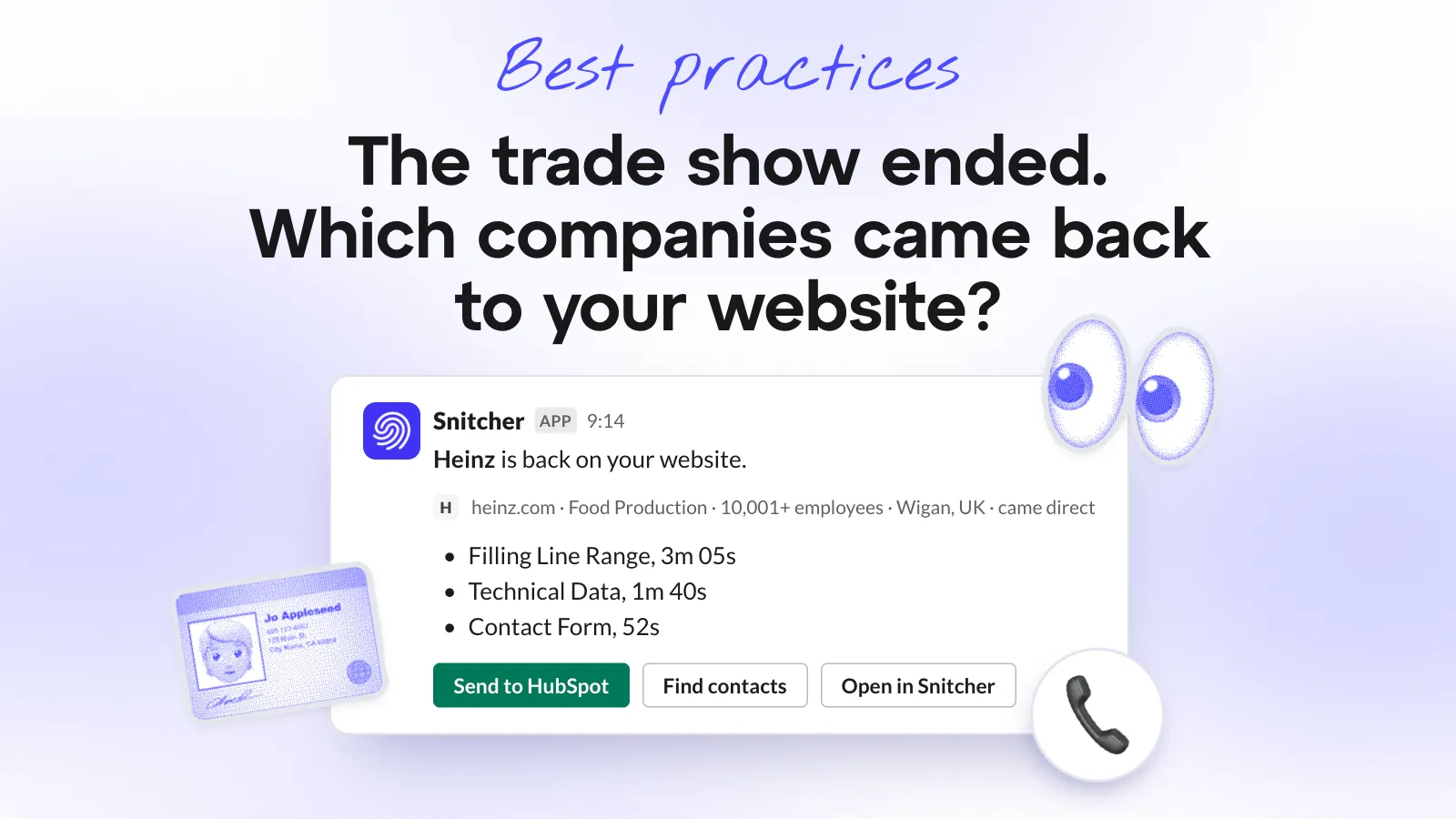
Here’s what that looks like. Say you make filling lines and I’m on your stand. On day two, I spend ten minutes with a production manager from Heinz, talking about whether the line can cope with thick sauces.
A week later, this turns up in my Slack channel:
- SnitcherAPP9:14 AM
1 new session has been recorded in your segment: Spring show – Dean
🏢 Heinz- Website
- https://heinz.com
- Stats
- Sessions: 3, pageviews: 11
- Industry
- Food Production
- Size
- 10,001+ employees
- Location
- Wigan, UK
- Original source
- (direct)
🕘 Recent activityAdded by Snitcher- Filling Line Range
- Technical Data
- Contact Form
 Dean Kirlew9:21 AM
ah that's the production manager I met on day 2, they wanted a trial on their thicker sauces. ringing them now

I didn’t have to spot that visit. Snitcher matched Heinz to the show list and posted it straight to me.


So I ring the production manager.
I don’t open with “I saw you on our website”. Nobody likes finding out they’ve been watched. It’s not a reason to talk either.
I pick up where we left off on the stand: “We ran that trial with a sauce like yours. Want to see the results?” The visit just told me this is a good week to ask.
No answer? Same thing, by email:
Hi Gareth,
Tried calling earlier – no worries if it was a bad time.
We ran the trial on the thicker sauce you mentioned at the show and the line kept up at full speed. Results are attached.
Worth 15 minutes this week to go through them? Thursday afternoon works my end.
Cheers,
Dean
What should you do in the six weeks after a show?
Keep checking for six weeks, not six days.
Most companies come back in the first two weeks, while the show is fresh. But nobody buys a filling line on impulse. Some only look you up a month later, once the budget’s signed off.
| When | What you do |
|---|---|
| Before the show | Put a QR code on the stand that goes to its own page. Anyone who lands there came from your stand |
| The day you’re back | Turn the scans into a list of companies and upload it to Snitcher |
| Weeks one and two | Check every morning and send each returning company to the rep who met them |
| Weeks three to six | Check once a week for the late ones |
| Week six | Count it up for your MD: how many you scanned, how many came back, how many went to sales and how many asked for a quote |
That last row is the one your MD actually cares about. “We scanned 212 badges” is nice. “Six companies asked for a quote” gets next year’s stand booked.
So, which companies came back?
Not as many as you scanned – and honestly, that’s how it should be. Most people stopped at your stand for the pen.
The ones who came back are the ones worth your reps’ time. If it were my show, I wouldn’t send a single follow-up email until I knew who they were.
So upload the list the day you’re back, give it two weeks, then hand each rep their own companies with what each one read.
Got a show coming up? Try Snitcher before you go, so the list is ready the day you get back.