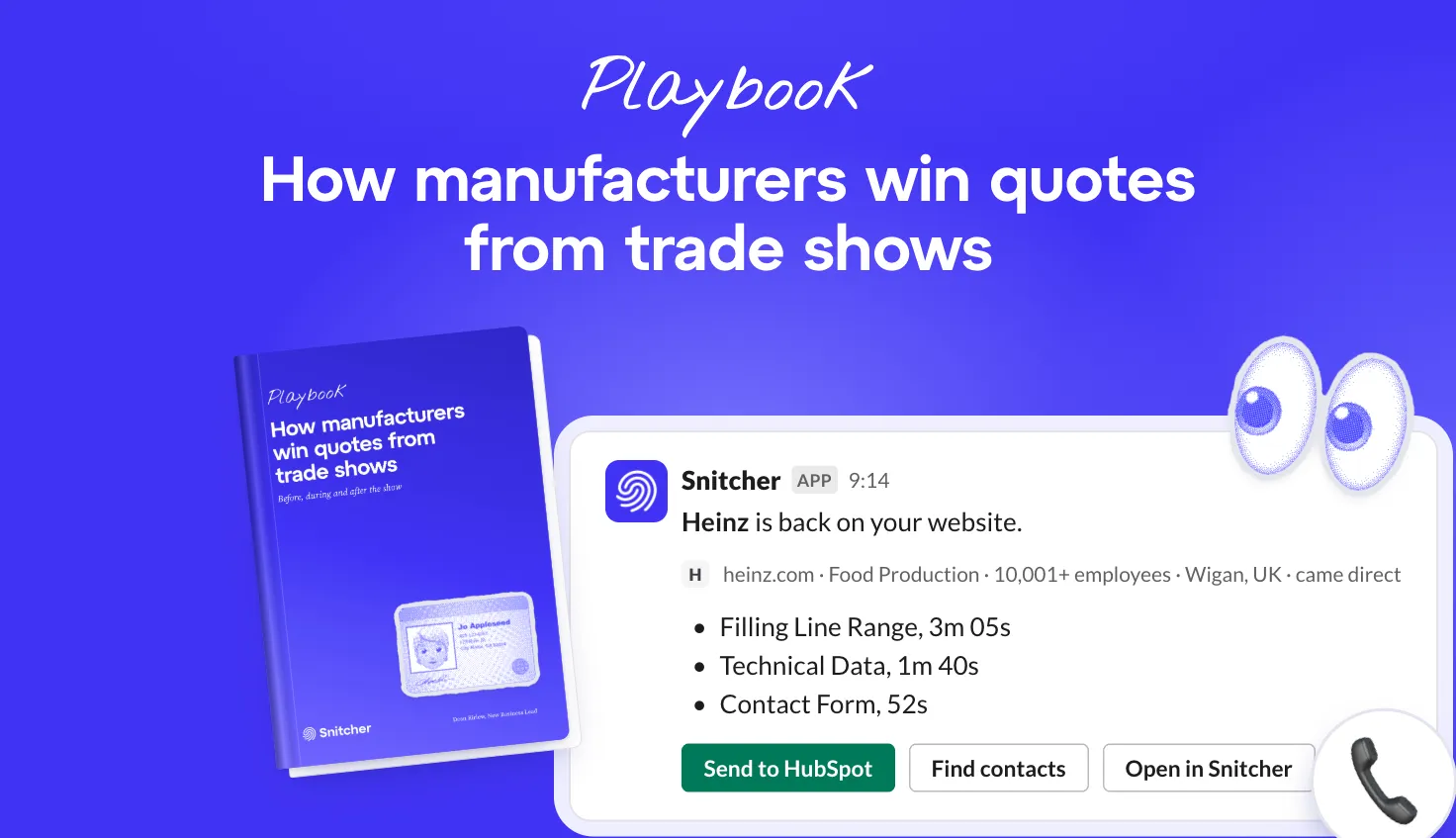
Your stand will talk to hundreds of people over three days. A handful will turn into quotes. Most of those start after the show, when a buyer gets back to their desk and reads up on you.
So decide who you want before the show. Then let your website tell you who’s serious.
Do that, and your reps spend the weeks after the show on the buyers who are deciding. The ones who stopped for a coffee can wait. (They’ll get the newsletter.) And when your MD asks if the stand was worth it, you’ll have the answer in one line.
1. Who do you want to meet at the show?
The companies you’d most like to win, whether they’ve heard of you or not.
Most of the buyers you want will walk straight past your stand. They’ve got a list of stands to see and a train to catch (and sore feet by lunchtime).
A buyer from a company you’d love to win clocks your name, keeps going and looks you up a week later. If nobody’s watching for them, you’ll never know they were there.
Snitcher is how you watch for them.
It tells you which companies are on your website and what they’re interested in, from the pages they read and how often they come back.
It works because someone reading your site at work is on their employer’s network, and that network names the company. Nobody has to fill in a form. (Most people never do.)
Then it brings that to you where you already work. That’s a report in your inbox, a message in Teams or Slack, or a record in your CRM.


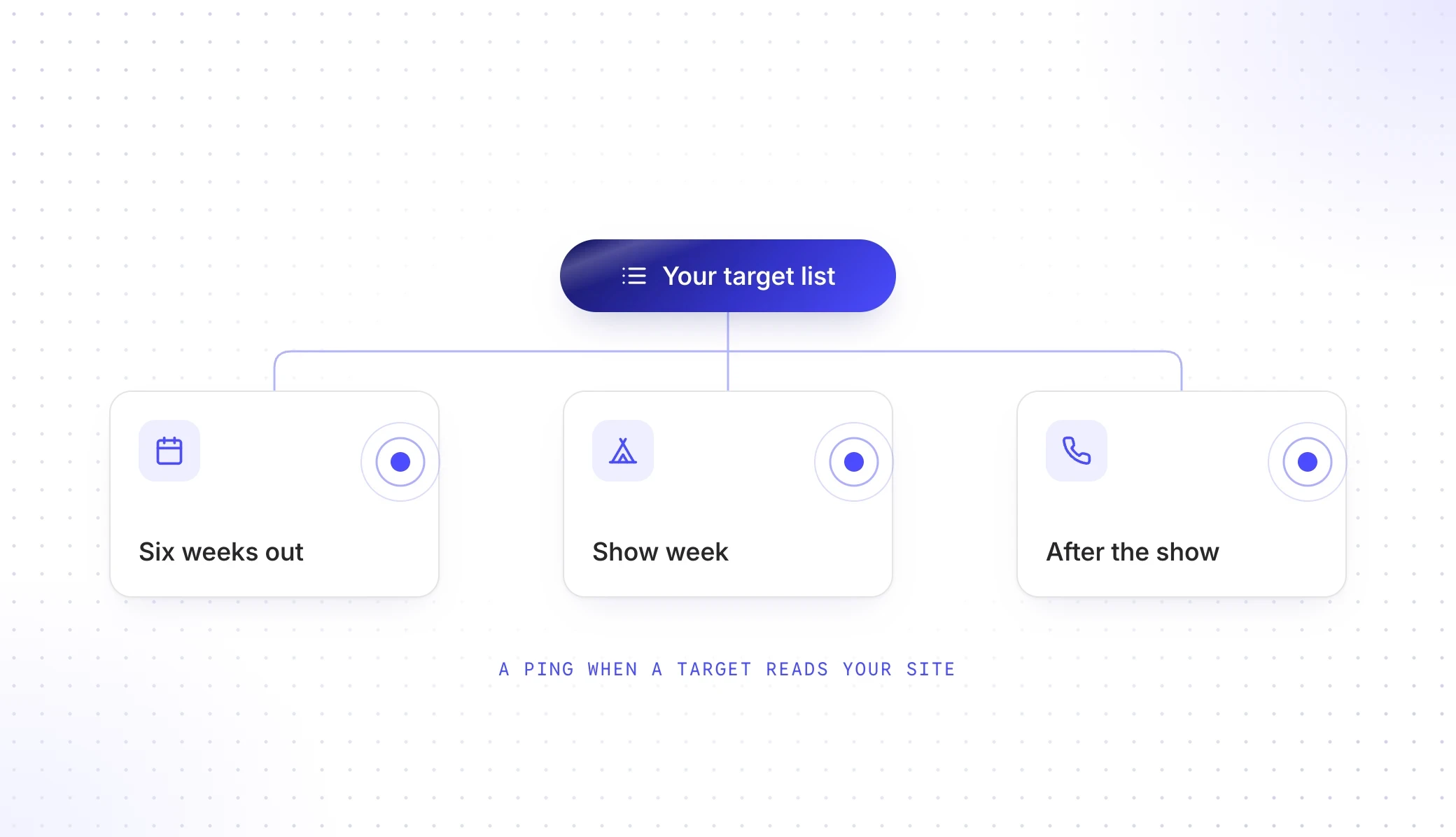
So before the show, you’ll upload your target list. From then on, you’ll know the moment any company on it starts reading your site, and what it’s looking at. That’s before the show, during it and after it.
Step 4 is the only email you send before the show. Make it about the product, not the visit (nobody likes feeling watched). Say you make filling lines, and Snitcher shows someone at Britvic has read your product pages three times this month:
Hi Emma,
We’re bringing our new filling line to the spring show, and it’ll be running at full speed on stand B42.
If you’re going, come and see how it handles your bottle sizes. Does Tuesday at 11 or Wednesday at 2 work?
Dean
2. How do you make every conversation at the stand count?
Swap the badge scan for a QR code, and write one line about every chat.
A badge scan gives you a name and a company. It doesn’t tell you what they wanted, and “can I scan your badge?” feels like a toll booth. (Most people say yes to be polite.)
By the last afternoon, nobody remembers who asked about the stainless version and who wanted a price for three lines.
Give people a reason to scan you instead.
Put a QR code on the stand, on the counter and on the back of your business cards. It opens a page on your website with what they asked about, like the spec sheet, the price list or a trial slot. They leave their name and email to get it.
That swap gets you three things a badge scan can’t:
| Badge scan | Your QR code | |
|---|---|---|
| What they want | Not recorded | The spec sheet or trial they picked |
| Their details | Whatever the badge says | An email they chose to give you |
| Who they spoke to | Lost, unless someone writes it down | Built in, if each rep has their own code |
And because they signed up on your website, the conversation doesn’t end at the stand. When their company reads your site again from the office next week, you’ll see it, along with the pages they read.
Keep scanning badges for anyone who won’t scan the code, and add one line to each: what they asked about, and what you promised. “Heinz, wants a trial on thicker sauces, results in two weeks” is next week’s phone call, written for you. “Nice chat” isn’t.
The note you write on day one is the call you make on day ten.
Your target list keeps working while you’re on the stand, too. If a target starts reading your site during show week, their rep gets a message in Teams or Slack. There’s still time to book them in before the doors close.
3. Who came back after the show?
The people you met who looked you up again from their desks, plus the targets who never stopped by.
You’ll come home with a pile of badge scans and QR sign-ups, and sales will want to know where to start. The pile can’t tell you.
A buyer with a project due in March looks just like someone who stopped for the coffee. (We’ve all taken a brochure to be nice.)
What they do next can. Someone with a real project goes back to the office and reads up on you. Someone who was being polite doesn’t.
So upload the pile to Snitcher the day you’re back, and let it do the sorting.
Every company from the show that visits your website lands in one list, with the pages it read and how often it came back. Say your 212 scans come down to 140 companies, and 31 of them visit your website in the two weeks after the show.
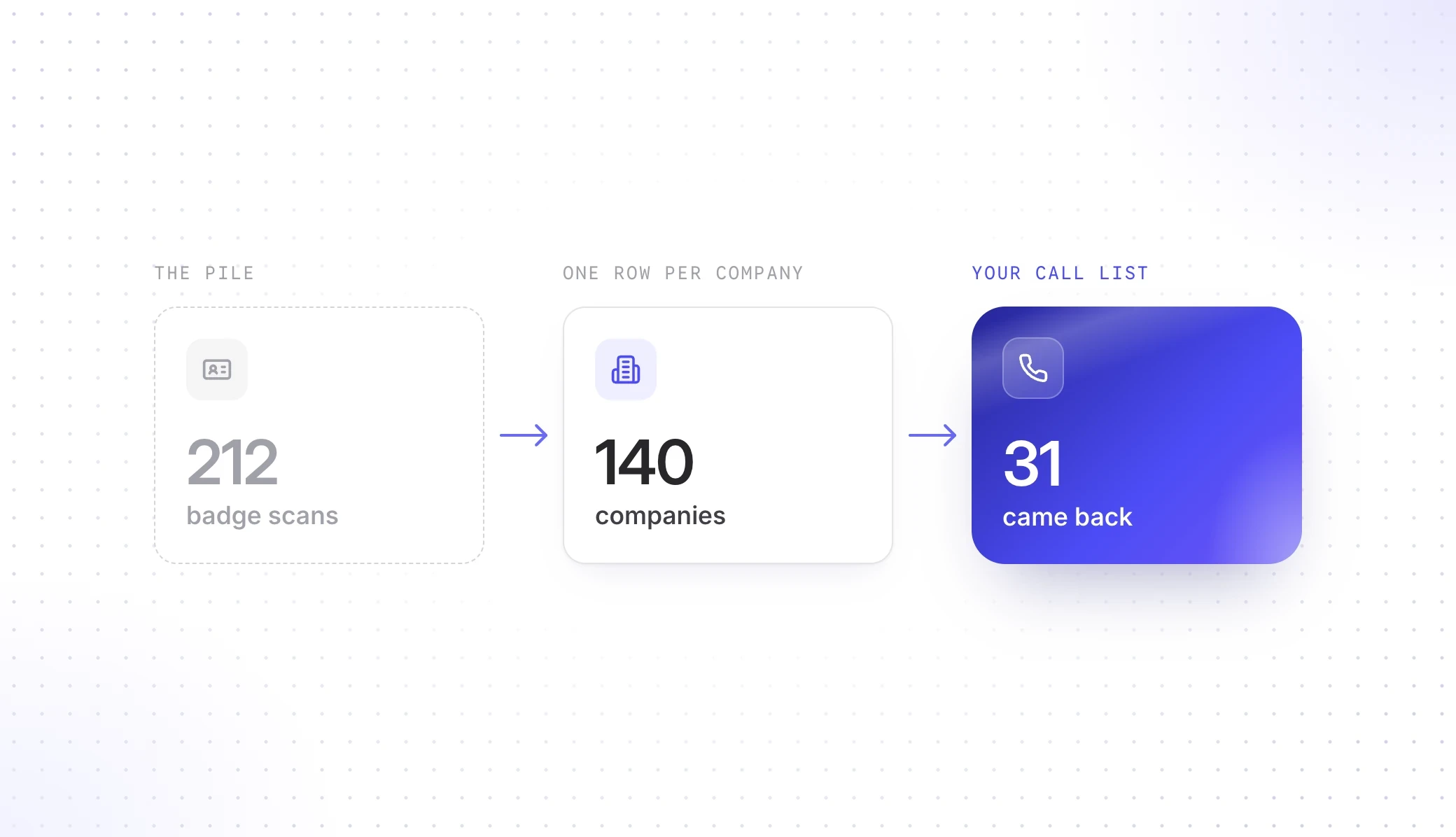
Those 31 are your call list.
Add the targets who never stopped by but read up on you anyway. The other 109 can wait for the newsletter. And you don’t need a spreadsheet to keep track of any of it, because the list in Snitcher is the tracker.
4. Who do you call first, and what do you say?
Start with the companies on the pages people read just before they ask for a quote. Then the rep who met them makes the call.
You’ll see what each company read when it came back. That’s a clue to what it wants next, so your rep can have it ready before they’re on the phone:
| What Snitcher shows | What it means | How your rep opens the call |
|---|---|---|
| Lead times, delivery or your quote page | They’re working out costs | ”I can get you a price by Friday. Want one?” |
| The product they saw on the stand | The conversation was real | ”We talked about the line on the stand. Shall I send the spec sheet?” |
| The same pages, from a different site | Someone else is involved | ”Who else on your side should see this? Happy to walk them through it.” |
| A target that never stopped by | They noticed you anyway | ”We were at the spring show and missed you. Shall I send over the spec sheet?” |
| Your homepage, once | Good manners | Nothing yet. Don’t ring |
Lead times and quote pages go to the top of the list.
A company that’s working out what your machine costs is closer to an order than one reading your “about us” page. (Nobody’s reading those for fun.)
To sort the rest, every company gets an intent level and a grade for how closely it matches your best customers, so nobody’s guessing.
And whoever rings shouldn’t open with “I saw you on our website”.
The visit tells your rep it’s a good week to call. The project is what they talk about, and the rep who met them is the one who remembers it.
Each rep can get their own companies in Teams, Slack, their inbox or your CRM, split by rep or region, so nobody’s forwarding a spreadsheet.
The third row is the one to jump on.
Say your rep spent ten minutes on the stand with an engineering manager from Müller. They talked about whether your line could fill Müller’s new yoghurt pots.
A week later, there’s a visit from a different Müller site, reading the same product page twice. That’s often the person who signs off the order, and nobody on your side has met them yet.
- SnitcherAPP8:52 AM
1 new session has been recorded in your segment: Spring show – Dean
🏢 Müller- Website
- https://muller.co.uk
- Stats
- Sessions: 2, pageviews: 7
- Industry
- Food Production
- Size
- 5,001-10,000 employees
- Location
- Market Drayton, UK
- Original source
- (direct)
🕘 Recent activityAdded by Snitcher- Filling Line Range
- Technical Data
- Filling Line Range
 Dean Kirlew9:03 AM
that's a different Müller site to the one I met. sending the trial results over and asking who else should see them

So your rep rings to say the trial results are in, then asks who else should see them.
If the call goes to voicemail, send this the same day:
Hi Tom,
Tried calling earlier, no worries if it was a bad time.
We ran the trial we talked about at the show, and the line filled your pots at full speed. I’ve attached the results.
Worth 15 minutes this week to go through them? Thursday afternoon works my end.
Dean
5. Was the show worth it?
You’ll know at week six, but your MD will want a first read before that.
The numbers are there from the day you’re back, so give your MD a first read after two weeks. Make the call at week six, once the late lookers have turned up. Nobody buys a filling line on impulse (not even after a good show).
Your MD doesn’t want to hear “we scanned 212 badges”. (They hear it every year.) They want to know whether the stand paid for itself, and whether to book it again.
The number your MD wants isn’t badges. It’s quotes.
Half of what you need is already in Snitcher: the companies you met, how many came back and how many look like your customers. Your reps add the calls and quotes, and you’ll add what the stand cost.
Then see what the numbers are telling you:
| What you see | What it means | What to do |
|---|---|---|
| At least one company asked for a quote | The show works | Book it again, if one order is worth more than a quote cost you |
| Good companies came back, but nobody’s asked for a quote | The follow-up isn’t landing | Fix the calls before you drop the show |
| Companies came back, but most don’t look like your customers | Wrong crowd | Try a different show, or a different hall |
| Nobody came back | It isn’t working | Drop it, and say so before your MD does |
And send your MD one line: “We met 140 companies at the spring show. 31 came back to our website, 24 got a call and 6 have asked for a quote.” Put it at the top of the email, so they get the point before they open anything.
Don’t switch it all off at week six. Quotes and orders keep landing for months, so leave the show list running in Snitcher and keep adding to the count. (If the organiser wants a rebooking answer at the show itself, go on last year’s count.)
Between shows, your website still gets the same kind of visitors as your stand. Give one person the job of reading them, with the week’s companies in their inbox every Monday as a PDF.
By the next show, that Monday list will have built most of your target list.
So, how do you turn a show into quotes?
Decide who you want before you go, and put them in Snitcher. On the stand, swap badge scans for a QR code and write a note about every chat.
When you’re back, let Snitcher sort the pile, then call the companies that came back, starting with the ones on your quote pages. The rep who met them makes the call, and talks about the project. Count the quotes at week six, and keep counting.
Here’s the whole show in one table:
| When | What you do |
|---|---|
| Six weeks before | Put your target list into Snitcher |
| The weeks before | Email the targets Snitcher flags, and make your QR codes |
| Show days | QR codes over badge scans, a note on every chat and a debrief each evening |
| The day you’re back | Upload the show list to Snitcher and send what you promised |
| Weeks one and two | Call the companies that came back, hottest first, and give your MD a first read |
| Weeks three to six | Check once a week for the late ones |
| Week six | Make the call on the show and send your MD one line |
| After that | Add quotes and orders as they land |
Snitcher does the tracking. Your reps just pick up the phone.
Got a show coming up? Try Snitcher before you book the hotel, so your target list is warming up by the time you set off.